
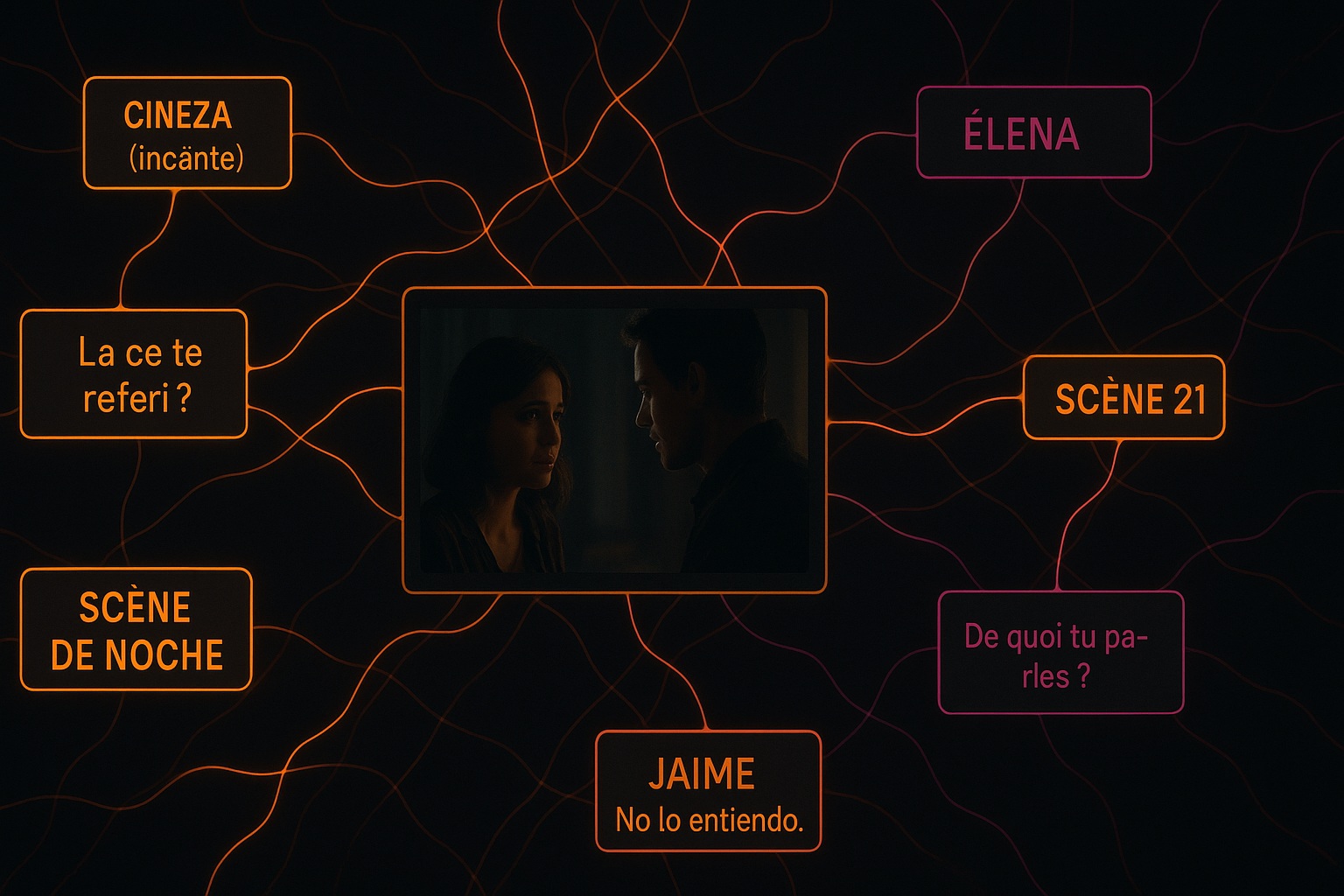
The Problem Nobody Talks About
Open any AI translation tool. Paste a subtitle. Get a translation. It works, right?
For a single sentence, yes. For a 90-minute film with recurring characters, emotional arcs, and dialogue that builds on itself — absolutely not.
Here's what happens when standard AI translates your film: Every subtitle gets processed in isolation. The AI has no idea that Maria in subtitle #47 is the same Maria from subtitle #12. It doesn't know that the tense confrontation in scene 8 is the payoff for the whispered secret in scene 2. It translates words. It doesn't translate meaning.
The Gender Agreement Disaster
Let's get specific. In Romanian, Spanish, French, Italian, Portuguese, Polish, Russian, and a dozen other languages, adjectives must agree with the gender of the person being addressed. This isn't optional — it's fundamental grammar.
When a character says "You're beautiful" in English, it's gender-neutral. But in Romanian:
| Speaking to | Correct Romanian | Literal meaning |
|---|---|---|
| A woman | Ești frumoasă | You are beautiful (feminine) |
| A man | Ești frumos | You are beautiful (masculine) |
Standard AI doesn't know who's being addressed. It guesses. Sometimes it guesses wrong. And when your romantic lead suddenly addresses the female protagonist with masculine adjectives, your audience notices. Immersion breaks. Your film feels amateur.
This happens constantly with sentence-by-sentence translation. The AI sees "You're beautiful" and picks a form — often defaulting to masculine because that's statistically more common in training data. Your Maria becomes Mario. Your tender moment becomes a translation error.
What Context-Aware Translation Actually Does
Context-aware translation works differently. Before translating anything, the system analyzes your entire script — understanding who your characters are, how they relate to each other, and how scenes connect narratively.
When the AI finally translates subtitle #47, it already knows that Maria is female, that she's being addressed by Thomas (her former partner), and that this confrontation echoes their first meeting in scene 2. It doesn't guess. It knows.
The result: every pronoun lands correctly. Every gendered adjective matches. Every callback preserves the original phrasing. Your story survives the translation intact.
Real Examples: Before and After
Let's see what this looks like in practice.
Example 1: The Pronoun Problem
English dialogue: "They said they'd help us."
Standard AI might translate this into French as "Ils ont dit qu'ils nous aideraient" — using masculine "ils" (they). But context-aware translation knows that "they" refers to Anna and Sophie, two female characters established earlier. The correct translation: "Elles ont dit qu'elles nous aideraient."
Example 2: Consistent Character Voice
A character who speaks formally in scene 1 should maintain that formality in scene 15. Standard AI has no memory — it might flip between formal and informal registers randomly. Context-aware translation maintains character voice consistency across your entire film.
Example 3: The Callback
Your script has a callback — a line in the third act that echoes something from the first. In English, both use the same phrasing. Standard AI might translate them differently because it processes them separately. Context-aware translation recognizes the repetition and preserves it.
Why This Matters for Filmmakers
You spent months — maybe years — crafting your script. Every word choice was deliberate. Every character voice was developed. Every callback was planted.
Standard translation erases that work. It gives you technically correct words arranged in technically correct sentences that somehow miss everything that made your script yours.
Context-aware translation preserves your intent. Not just your words — your meaning. The emotional beats land where they should. The character voices remain distinct. The story survives the translation.
The Languages That Need It Most
Context-aware translation matters for every language, but it's absolutely critical for languages with grammatical gender agreement:
- Romance languages: Spanish, French, Italian, Portuguese, Romanian
- Slavic languages: Russian, Polish, Czech, Bulgarian, Serbian, Croatian, Ukrainian
- Semitic languages: Arabic, Hebrew
- Indo-Aryan languages: Hindi, Urdu
In these languages, translation errors aren't subtle. They're grammatically wrong. Native speakers notice immediately. Your film loses credibility before the second scene.
How WOCOO AI Subtitles Does It
We built our context-aware system from the ground up, developed through years of running the WOCOO video-on-demand platform. We've processed thousands of films across 45 languages. We've seen what breaks and what works.
Our proprietary analysis system runs automatically on every subtitle file. You upload your SRT, select your languages, and the system handles the rest. No manual character tagging. No scene-by-scene configuration. The AI understands your story.
The result: professional-quality translations that preserve your voice and get the grammar right — in minutes, not weeks.
See context-aware translation in action with your own subtitle file
Frequently Asked Questions
The system uses scene context and character relationships to resolve ambiguity. If a line could be interpreted multiple ways, it considers who's speaking, who's listening, and what's happening in the scene. When genuine ambiguity exists in the source, we preserve that ambiguity in the translation rather than making arbitrary choices.
The analysis passes add processing time, but we're talking minutes, not hours. A 90-minute film typically completes in 10-15 minutes total. The quality improvement is worth the additional seconds.
Our system uses multiple signals from your script to identify gender accurately. In rare edge cases where the script itself is ambiguous, you can specify character details before translation. But for the vast majority of films, the AI gets it right automatically.
Yes, though you'll see the biggest benefits with longer content where character relationships develop over time. For a 30-second ad, standard translation might be fine. For a feature film, documentary, or series episode, context-awareness is essential.
Yes. Our system applies context-aware analysis to every language we support. The gender agreement features are especially critical for Romance, Slavic, and Semitic language families, but the character consistency and scene understanding benefits apply universally.
The Bottom Line
Sentence-by-sentence translation is fine for a restaurant menu. It's not fine for your film.
Your story deserves a translation system that understands it. One that knows Maria is a woman and Thomas is addressing Elena and the callback in act three matters. One that treats your screenplay as a story, not a spreadsheet.
That's what context-aware translation delivers. That's what makes the difference between subtitles that work and subtitles that disappear — letting your audience experience your film, not your translator's guesses.
€100 flat rate per language. Any length. Context-aware quality.